You can't control the AI answer. You can control what it has to work with.
Every few weeks, an AI interface changes how it presents recommendations. Chasing that is a treadmill. The work that lasts is one layer down — in the evidence these systems retrieve, associate, and repeat.
Ask ChatGPT who to hire for something today, and you might get a tidy numbered list with citations. Ask the same question next month and the citations could be gone, replaced by a single confident paragraph — or a follow-up question, or a comparison table, or a two-pane view that didn't exist before. Claude and Gemini are on their own schedules. Google keeps rearranging what sits above the old blue links.
It's tempting to treat each of these as a thing to optimize for. Someone notices citations appearing, so the plan becomes "get cited." The layout changes, so the plan changes. This is a losing game, because none of it is yours to control. The interface is a product decision made by a company that has never heard of your business.
Don't optimize for the interface. Build the authority underneath it.
The reason this matters isn't philosophical. It's that there's a stable layer beneath all the churn, and almost everything worth doing lives there.
What actually happens before an answer appears
Whatever the interface looks like, a recommendation has to survive a chain of steps before it can reach a customer. It helps to name them, because "we're not showing up in AI" is rarely one problem — it's a specific link in the chain that's broken.
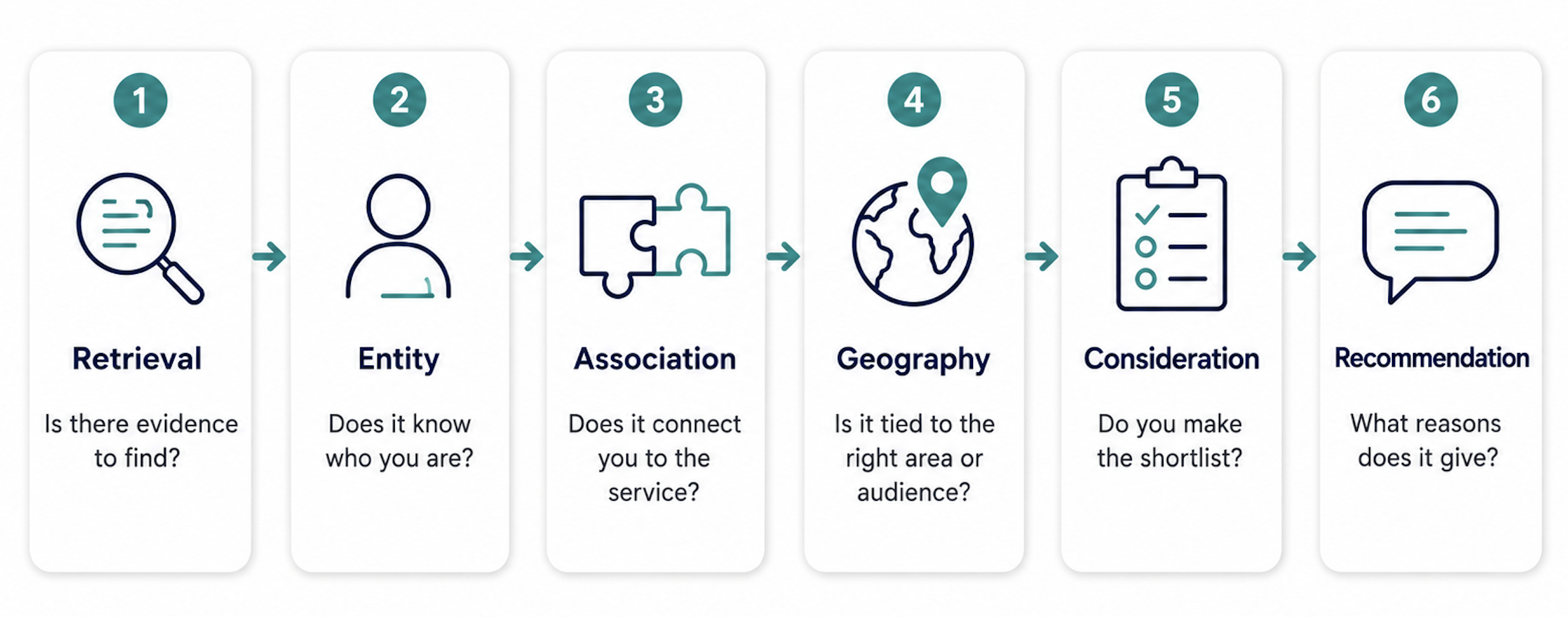
Every one of these is about information the system can read, and every one is something you can influence. Is there enough evidence out there to retrieve at all? Once retrieved, is it obvious which organization it refers to — or are you being confused with three other businesses that share your name? Are you connected to the service someone's actually asking about, or just described in vague terms? Does the record place you in the right city, the right specialty, the right kind of client?
When a business "isn't in the AI answer," it's almost always failing at one of these links in particular. The fix for a broken association — the model knows you exist but never connects you to the job you're best at — is completely different from the fix for broken retrieval, where there's simply not enough out there to find. Naming the break is most of the work.
The interface changes. The evidence doesn't have to.
Here's the useful consequence. A clear, well-structured description of what you do, who you serve, and why you're credible is useful to a citation-style interface and a single-paragraph one and whatever comes next. Evidence that a third party vouches for your expertise helps in a comparison table and in a conversational follow-up. None of that has to be re-done when the layout shifts.
So the durable work is unglamorous and specific:
- Describe the organization clearly enough that a system can tell exactly who it is.
- Associate it — in plain, retrievable text — with the services and the customer problems it should be found for.
- Get the geography, audience and scope right, so it's not recommended where it can't help.
- Support claims with evidence a system can actually point to.
- Make the important information easy to retrieve, rather than buried in an image or a script.
- Earn third-party references, because a business vouching only for itself is weak evidence.
Notice what's not on that list: tricks to appear in a specific product, or promises about a specific model's behavior. Nobody can guarantee a ChatGPT recommendation or an AI citation, and anyone who says otherwise is selling the interface, not the authority.
More visible isn't the goal. Authority where it pays is.
There's a second trap next to the first one. Once you accept that you can shape the underlying evidence, the instinct is to shape all of it, everywhere. Publish more. Get mentioned more. Be visible for everything.
The goal is not to become more visible everywhere. It's to become more authoritative where visibility has commercial value.
A mobile service business discovered for towns it doesn't serve doesn't need more visibility — it needs the right association and geography. A professional-services firm whose entire non-brand discovery runs through a single strong article doesn't need to publish ten thin ones; it needs to understand what authority the market has already granted it and build on that. Visibility only counts when it reaches someone who can become a customer.
How to work on it without guessing
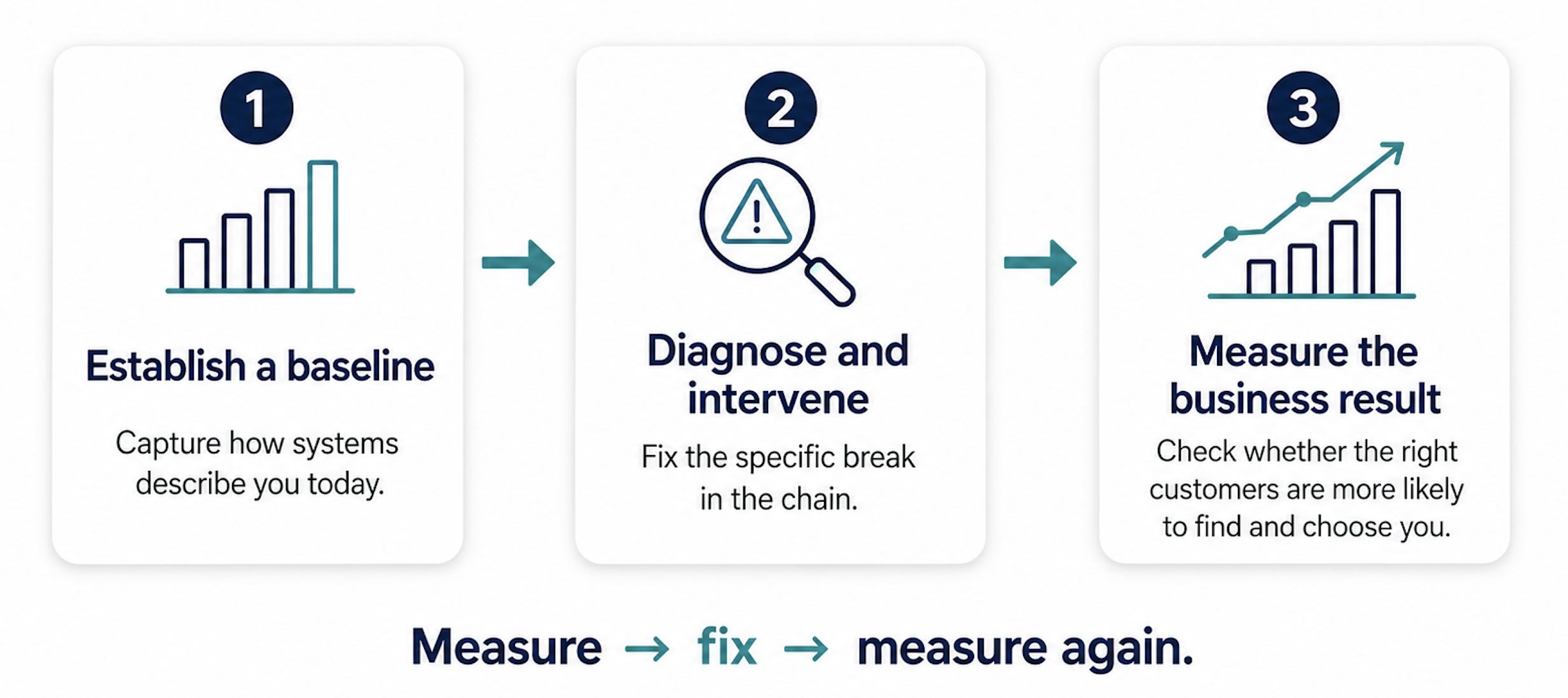
If the evidence layer is what matters, then the honest way to work on it is to measure it before you touch anything. Capture how the systems currently describe you and where in that chain they break. Change the specific things the diagnosis points to — and log why, and which measure you expect each change to move. Then run the same measurements again and see whether the right people actually became more likely to find and choose you.
That's the whole discipline, and it's deliberately boring: establish a baseline, diagnose and intervene, measure the business result. It works precisely because it doesn't depend on predicting what the interface will do next. It depends on the layer underneath, which you can see, change, and check.
The AI answer will keep changing. What it has to work with is up to you.
Want to see where your own discovery chain breaks? Start with a baseline: capture how the systems describe you today, and name the link that's broken. Everything else follows from that.
Keep reading