
Not every visibility problem is a content problem.
Sometimes the website is genuinely good — the services are clear, the pages are organized — and the business still barely shows up. That's when the diagnosis gets interesting, because the reflex to publish more is treatment prescribed before a cause.
Sometimes the website is good. The services are clearly explained, the pages are organized, and the business still barely shows up. That's when the diagnosis gets interesting.
Most digital marketing advice starts with the same prescription: publish more content. Not ranking for an important service? Build a page. Not appearing for a customer question? Write an article. Not showing up in AI recommendations? Add FAQs, schema, location pages, comparison pages, expert commentary.
Sometimes that's exactly right. Sometimes it isn't.
We recently analyzed the public web presence of an aging-in-place and home-accessibility business, and what caught our attention was that the website didn't have the problems we usually find. The services were clearly organized. The language reflected real customer problems, not internal company jargon. There were dedicated pages for the important services and locations. The positioning was differentiated. The site was genuinely useful.
And its organic search visibility was still extremely limited.
That raised a better question than “what content should they add?” The better question was: what if content isn't the problem?

A good website is one layer of digital authority — not the whole thing
Search and AI systems don't evaluate a business by reading its homepage and deciding whether they like it. They work from a much larger information environment. Your website matters because it's the clearest source you control — it explains what you do, who you serve, where you operate, what you know. But a beautifully structured website doesn't automatically mean these systems will confidently surface the business.
A company can explain itself perfectly and still lack evidence elsewhere. Its entity may be poorly understood. Its expertise may not be corroborated. Its pages may not have accumulated authority yet. Its visibility may be attached to the wrong customer intent. Or the business may simply be too new for the signals to have developed.
From the outside, all of these look the same: the business isn't showing up. But they're very different problems, and treating all of them with more content is prescribing the treatment before you have a diagnosis.
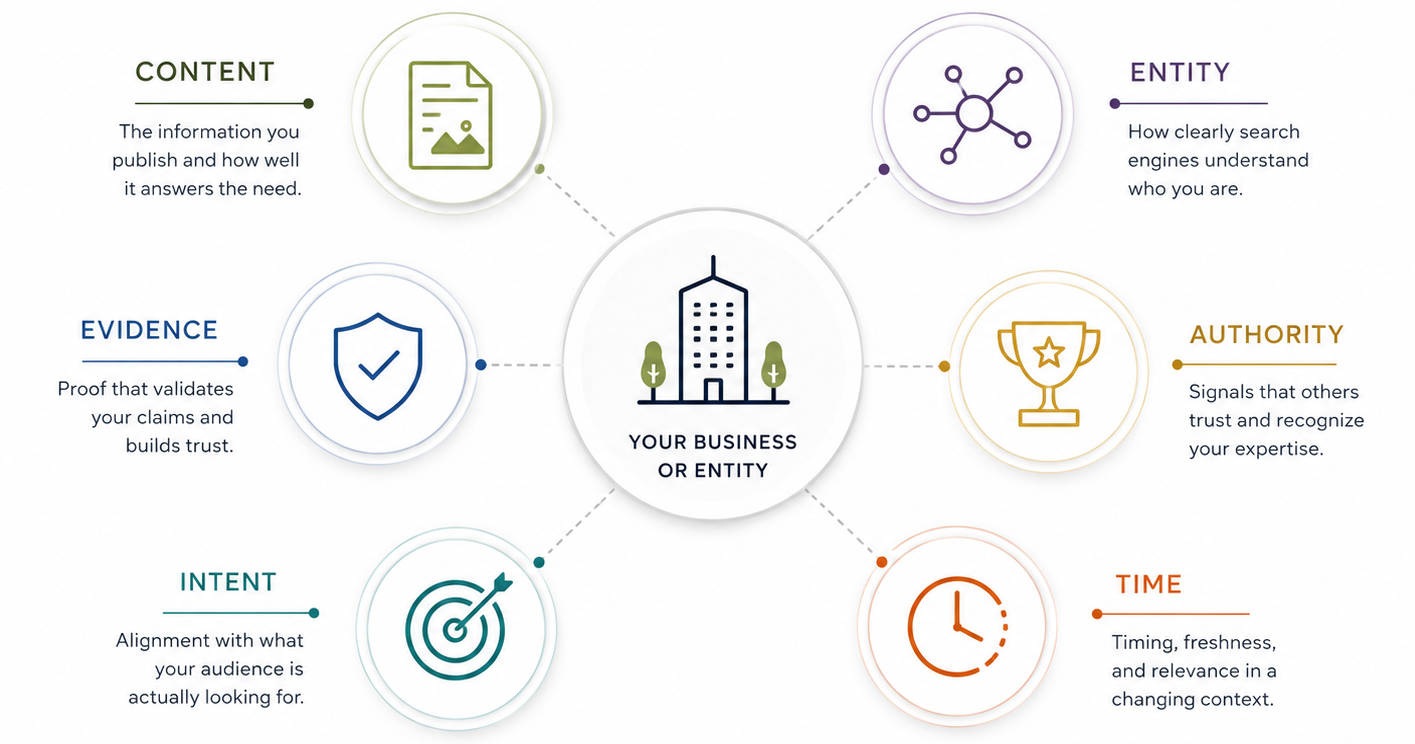
There are six distinct problems that produce this one symptom.
1. The information problem
This is the one everyone thinks of first, and sometimes it really is the answer. A company with deep real-world expertise can still fail to explain it online. The website is organized around internal departments instead of customer problems. Important services are buried. Different audiences are mixed together. The questions customers actually ask never get answered.
When that's the diagnosis, information architecture and content genuinely help. But the objective isn't to publish more — it's to make the business easier to understand. What does the company do, for whom, under what circumstances, and what evidence backs the claims? Those relationships have to be explicit enough for both humans and machines to follow.
That's one possible diagnosis. There are five more.
2. The entity problem
Sometimes the information exists, but the systems still can't answer a more basic question: what exactly is this business?
This happens more than you'd expect. The company operates in multiple categories. The legal name differs from the brand name. It shares a name with another company. Its locations are represented inconsistently. Or its strongest historical identity no longer reflects what it wants to be known for.
Take that accessibility business — it combines home assessment, construction, mobility equipment, and aging-in-place consulting. A human looks at that and gets it. A retrieval system has to decide what type of entity it's dealing with before it can decide when that entity belongs in a recommendation. Is it a contractor? A medical equipment supplier? A senior-care service? Those classifications determine which questions the business is even eligible to answer.
The fix here isn't another article. It's stronger, more consistent signals about who the company is.
3. The evidence problem
A website can make excellent claims. That doesn't mean the claims carry weight.
There's a difference between “we specialize in complex cases” and a named specialist with specific credentials, documented casework, professional affiliations, and third-party recognition. The second gives a search or AI system something to work with.
We think of this as the difference between claim architecture and evidence architecture. A company can have beautiful copy explaining why it's qualified — but if all of that authority is self-declared, there's not enough corroboration for systems to treat it as a leading source. Credentials, licenses, case studies, reviews, media coverage, industry references, independent mentions of the business and its people: that's the material that turns a claim into evidence.
If this is the gap, another generic article does almost nothing.
4. The authority problem
Sometimes the website is genuinely good, the entity is clear, the expertise is real — and the broader web just doesn't know enough about the company yet.
Authority accumulates. A competitor with ten years of history has hundreds of reviews, local citations, manufacturer listings, backlinks, branded searches, and thousands of prior customer interactions. A newer company can publish a better page tomorrow, and that page will not erase ten years of accumulated signal.
This is the uncomfortable part: better content does not mean stronger authority. Sometimes the work is outside your own website entirely — partnerships, professional associations, earned coverage, reviews, authoritative directories. Your website can describe your authority. The rest of the information environment is what validates it.
5. The intent problem
This one is easy to miss because the analytics look good. A business can have rankings, traffic, thousands of keywords — and still be attracting the wrong kind of discovery.
Imagine that accessibility business getting strong visibility for “correct height for a shower grab bar.” Relevant, sure. But compare it to: my mother has Parkinson's and can no longer safely use the stairs — who can evaluate her home and tell us what needs to change? The first query is an informational visitor. The second is a family ready to spend tens of thousands of dollars on a serious problem. Both count as visibility. They are not equally valuable.
The same test exists in AI discovery, and it's harder. A company may be well understood when someone searches its name. But does it enter the consideration set when the customer doesn't know the company's name — or even the right category? That's the test that matters commercially.
6. The time problem
Sometimes nothing is broken. This is the least satisfying diagnosis because there's no dramatic fix. The site is sound, the entity is clear, the right pages exist — the business just hasn't accumulated enough history. Pages need to be indexed. Entities need to become associated with topics and places. Mentions need to pile up. Systems need repeated evidence that a company belongs in a consideration set.
That doesn't mean sitting and hoping. It means being able to tell the difference between a strategy that's failing and a strategy that hasn't had time to prove itself. Companies that can't make that distinction end up rebuilding perfectly reasonable work every quarter because they expected every intervention to rank immediately.
The question changes
The standard question is “what should we publish?” The better starting question is: why is this business not being considered?
Those lead to very different work. If the problem is information architecture, restructure the information. If it's entity clarity, strengthen the entity. If it's weak evidence, create and surface credible proof. If it's external authority, work beyond the website. If it's intent mismatch, stop celebrating traffic that doesn't map to commercial demand. And if the foundation is strong but young, measure whether authority is accumulating before tearing everything down.
Sometimes content is part of the intervention. Sometimes it isn't.
Diagnosis before production
There's an understandable temptation to turn every marketing problem into production, because production is visible. You can count pages. You can build a calendar. You can report that twenty pieces shipped this month.
Diagnosis is less theatrical. It might conclude that the client doesn't need twenty new articles — that three existing pages need strengthening, that expert credentials need surfacing, that two business entities are being conflated, that the most important services lack third-party validation, or that the traffic coming in has almost no commercial value. That's harder to package into a content quota. It's also a much better foundation for deciding what deserves to be built.
AI has made this distinction more important, not less. Content production is now nearly free — any business can generate fifty articles, a hundred FAQs, an entire resource center by Friday. The hard part is no longer producing words. The hard part is deciding which information is actually missing, which claims need evidence, which customer situations matter commercially — and what not to build.
When everyone can produce volume, volume stops differentiating. Judgment is what's left.
The goal isn't more content. It's better digital authority.
We use the phrase digital authority deliberately. It's broader than a website, broader than rankings, and broader than whether a business happens to appear in one ChatGPT answer on one particular day. It's the full body of information and evidence that helps search and AI systems understand who the business is, what it genuinely knows, which problems it solves, where it operates, who its experts are, why its claims are credible, and when it belongs in the consideration set.
A website is an important part of that system. It is not the system.
That's why a good website can still be invisible — and why the first job isn't producing more content. The first job is figuring out what's actually missing.
Because not every visibility problem is a content problem.
Want to know which of the six is actually limiting your discovery? Start with a diagnosis, not a content quota: capture how search and AI systems describe your business today, and find which layer is doing the limiting. Everything else follows from that.
About the analysis: This article is based on independent analysis of publicly available websites and search data. Businesses are anonymized unless otherwise stated. Search visibility is a point-in-time observation and may change. Explanations of potential causes are hypotheses to be validated through additional data and measurement, not claims about the proprietary internal algorithms of any search engine or AI system.
Keep reading
You can't control the AI answer. You can control what it has to work with.
The interface keeps changing. The durable work is one layer down — in the evidence these systems retrieve, associate, and repeat.
How Rubricks works
Baseline, diagnose and intervene, measure the business result — the discipline behind diagnosis-before-production.